A founder's guide: how to start a medtech startup in Israel
To start a MedTech startup in Israel, define the intended use and device class first, then choose the regulatory path: FDA 510(k), De Novo or PMA in the US, CE marking under the EU MDR, and registration with the Israeli Ministry of Health. Clinical studies in Israel need Helsinki Committee approval, and Israel Innovation Authority grants can fund early R&D.
Start with the intended use, not the technology
In medical devices, the intended use decides almost everything that follows: the device class, the regulatory pathway, the tests, whether you need clinical data, and how much money you need to raise before the first sale. Two products built on the same technology can land in very different classes because of what they claim to do.
So before you build, write one clear sentence on what the device does, for which patients and in which setting. Then check how regulators classify devices with that use. Software counts too. The EU MDR, for example, states that software intended by the manufacturer for a medical purpose qualifies as a medical device in its own right, while general-purpose or wellness software does not.
Device classes in the US and the EU
FDA classifies devices into three classes by risk. Class I has the lowest risk and Class III the highest. Non-exempt Class I and Class II devices usually need a 510(k). Class III devices generally need a PMA (premarket approval). A novel device with no legally marketed predicate can use a De Novo request.
In the EU, the Medical Device Regulation (EU) 2017/745 divides devices into classes I, IIa, IIb and III, based on intended purpose and risk. Class IIa, IIb and III devices need a notified body in the conformity assessment. Most Class I devices are self-declared by the manufacturer, but sterile, measuring and reusable surgical Class I devices also involve a notified body for those aspects. The US and EU classes do not map one to one, so check both.
Choosing the US pathway: 510(k), De Novo or PMA
A 510(k) shows that your device is substantially equivalent to a device already legally marketed in the US. FDA's goal is a decision within 90 FDA days, not counting the time FDA waits for your answers. A De Novo request is for novel devices with no predicate, and FDA's goal is a decision within 150 review days. A PMA is the most demanding pathway, for most Class III devices.
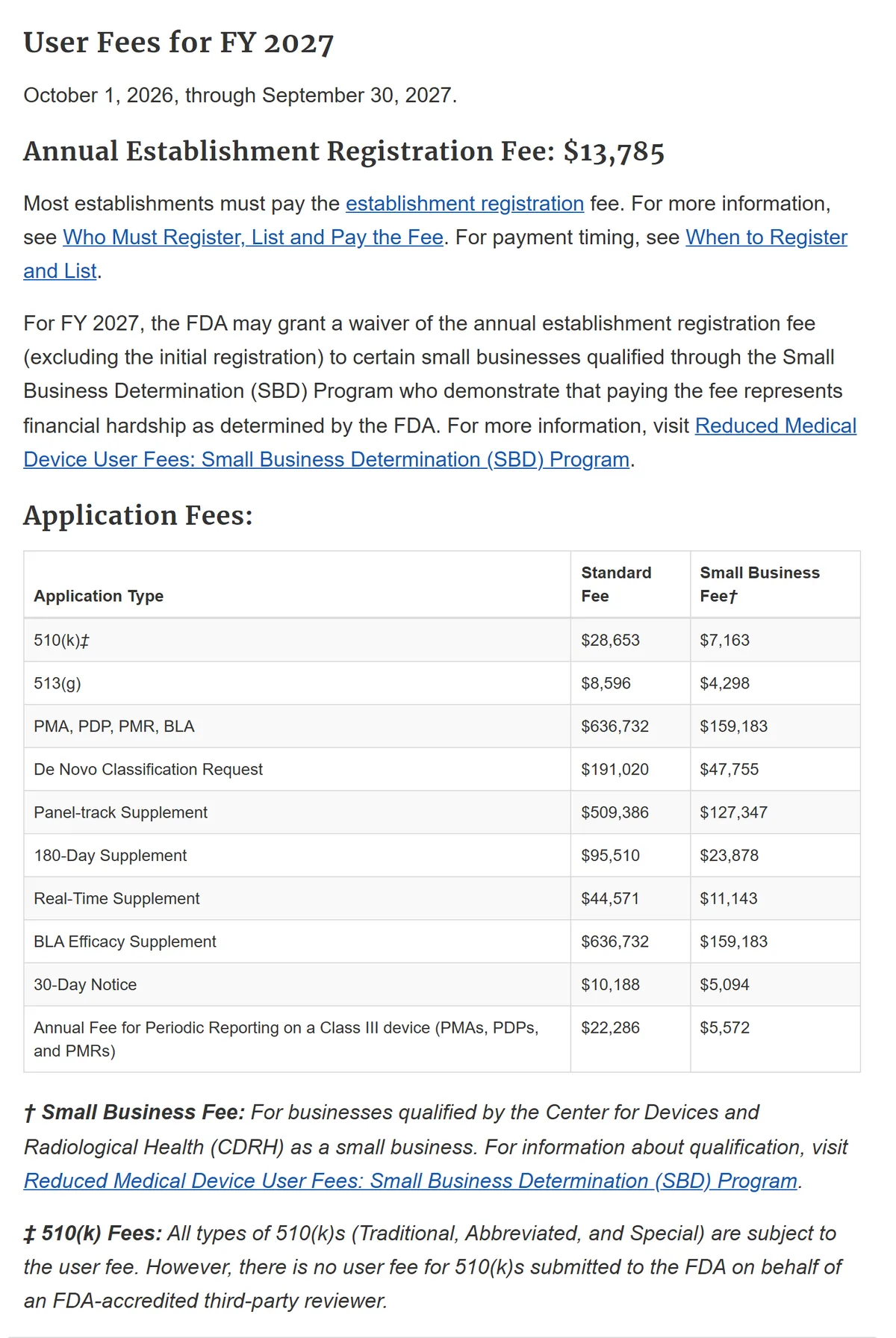
FDA fees for fiscal year 2027 (October 1, 2026 to September 30, 2027) show how different the pathways are:
- 510(k): $28,653, or $7,163 for a qualified small business.
- De Novo: $191,020, or $47,755 for a qualified small business.
- PMA: $636,732, or $159,183 for a qualified small business.
- Annual establishment registration: $13,785.
Ask FDA early
If you are unsure about the pathway, the predicate or the need for clinical data, FDA's Q-Submission program lets you send a Pre-Submission with specific questions. Under the current guidance, FDA sends written feedback within 70 days. It is voluntary and works best before you run expensive tests. Our 510(k) guide, /en/guides/fda-510k-israeli-startups, covers the steps in detail.
Selling in Israel: registration with the Ministry of Health
Under the Medical Equipment Law, 2012, medical equipment may be manufactured and marketed in Israel only if it is registered in the Ministry of Health medical equipment register, or listed in the law's second schedule. Registration requires the Ministry to be satisfied that the benefit outweighs the risk, that the device is effective and of suitable quality, and that it is made under proper manufacturing conditions.
The law has a route for devices that are already registered or allowed for marketing in a "recognized country" and marketed there. The law's first schedule lists those countries, and the list includes the United States, Canada, Australia and European countries such as Germany, France and the UK. For many startups this means the Israeli registration can follow a US approval rather than come first.
Clinical studies in Israel
Any medical study in humans in Israel, including a pilot of your device or a study on existing medical records, needs approval from the institutional Helsinki Committee and the written approval of the institution director, under the Public Health Regulations of 1980 and Ministry of Health Procedure 14. Some device trials are classified as "non-special" and need Ministry of Health approval too. See /en/guides/helsinki-committee-israel.
Data from a well-run Israeli study can support a US submission. Under 21 CFR 812.28, FDA accepts clinical data from outside the US for a 510(k), De Novo, PMA or IDE if the study follows good clinical practice, including approval by an independent ethics committee before it starts.
Funding the early stages
MedTech usually needs more capital and more time before revenue than software. Plan the raise around regulatory milestones, such as a Pre-Submission answer, a completed pilot or a submission, rather than around calendar dates.
The Israel Innovation Authority invests through non-dilutive conditional grants, from ideation through pre-seed, seed and A rounds. A grant is repaid only once the company has revenue from the funded project, through royalties of 3% to 5% of annual revenues plus annual interest based on SOFR, until the grant is repaid. The funded R&D must be done in Israel, and selling or transferring the funded know-how abroad needs IIA approval and a repayment. Check the current program terms on the IIA site before you apply.
Common mistakes
Early decisions that often cost founders time:
- Building the product before deciding on the intended use and class.
- Assuming the US and EU paths are the same, or that the Israeli registration comes first.
- Starting a pilot or a data study before Helsinki approval.
- Running a clinical study in Israel that does not meet the GCP conditions FDA expects.
- Planning the raise on optimistic review times instead of regulatory milestones.
How WeCcelerate works with MedTech founders
WeCcelerate is a Venture Builder in Israel since 2018, active in Tel Aviv and Jerusalem and recognized by the Israel Innovation Authority. Our MedTech track runs in partnership with Leumit Health Services and gives founders clinical expertise, regulatory guidance, data access and pilot opportunities, all subject to the required approvals. We work with founders on the intended use, the regulatory plan and the fundraising plan as one roadmap.
Step by step
Step-by-step
Validate the clinical need
Talk with clinicians in your target specialty to understand the workflow, the problem and whether your solution fits into routine care.
Write the intended use and classify the device
Define what the device does, for whom and where, then find its FDA class and its EU MDR class.
Choose the regulatory pathway
Decide between 510(k), De Novo and PMA for the US, CE marking under the MDR for the EU, and plan the Israeli registration.
Incorporate and build the team
Bring clinical expertise into the team or advisory board from the start.
Apply for non-dilutive funding
Check Israel Innovation Authority programs that fit your stage. The funded R&D must be done in Israel.
Get Helsinki approval for your study
Submit the protocol to the institutional Helsinki Committee, and to the Ministry of Health if the trial is non-special. Do not enroll before the director signs.
Prepare and file the submission
Use a Pre-Submission for open questions, then file with FDA or a notified body.
Talk to the WeCcelerate MedTech track
Book an introductory call about the MedTech track.
FAQ
Frequently Asked Questions
What is the first step in starting a MedTech startup in Israel?
What do FDA submissions cost in 2027?
Can an FDA clearance help me register a device in Israel?
Do I need Helsinki Committee approval for a pilot?
How do Israel Innovation Authority grants work?
Will FDA accept data from a clinical study in Israel?
Sources
The facts in this guide were checked against these official sources
- Classify Your Medical Device · FDA
- Medical Device User Fee Amendments (MDUFA): Fees · FDA
- De Novo Classification Request · FDA
- Regulation (EU) 2017/745 on medical devices · EUR-Lex
- חוק ציוד רפואי, התשע"ב-2012 · Knesset
- נוהל ניסויים רפואיים בבני אדם · Israel Ministry of Health
- Royalties & Intellectual Property · Israel Innovation Authority
- 21 CFR 812.28 -- Acceptance of data from clinical investigations conducted outside the United States · eCFR
Learn about the WeCcelerate MedTech track
The WeCcelerate team has supported ventures launched that collectively significant capital raised. Start with a free introductory call.
Related reads