FDA 510(k) Israeli startup guide: how to get a medical device cleared in the US
FDA 510(k) is a premarket submission showing that a medical device is as safe and effective as a device already legally marketed in the US. An Israeli startup may not market the device in the US before FDA issues its clearance. The FY2027 fee is $28,653, or $7,163 for a qualified small business.
What a 510(k) is and what you have to prove
A 510(k), also called a Premarket Notification, is a submission to the FDA showing that your device is as safe and effective as a device that is already legally marketed in the US. The legal standard is substantial equivalence (SE), and the device you compare against is called the predicate.
Substantial equivalence covers both safety and effectiveness. FDA first checks that the intended use is the same, then checks whether any technological differences raise new questions of safety or effectiveness. The two devices do not have to be identical.
You may not market the device in the US until FDA issues an order declaring it substantially equivalent. If FDA finds the device not substantially equivalent (NSE), or if no suitable predicate exists, the usual alternative is a De Novo request, the FDA pathway for novel devices with no legally marketed predicate.
Does an Israeli company need to file one?
FDA lists foreign manufacturers and exporters, or their US representatives, among the parties that must submit a 510(k) before introducing a device to the US market. An Israeli startup selling into the US is usually in this group.
Not every device needs a 510(k):
- Many Class I devices and some Class II devices are exempt, within the limits written in their classification regulation. A device that goes beyond those limits still needs a 510(k).
- Class III devices generally need a PMA (premarket approval), not a 510(k).
- A device still in development is not marketed yet. A clinical study in the US is regulated separately, under the IDE (Investigational Device Exemption) rules.
Step 1: find your product code in the FDA classification database
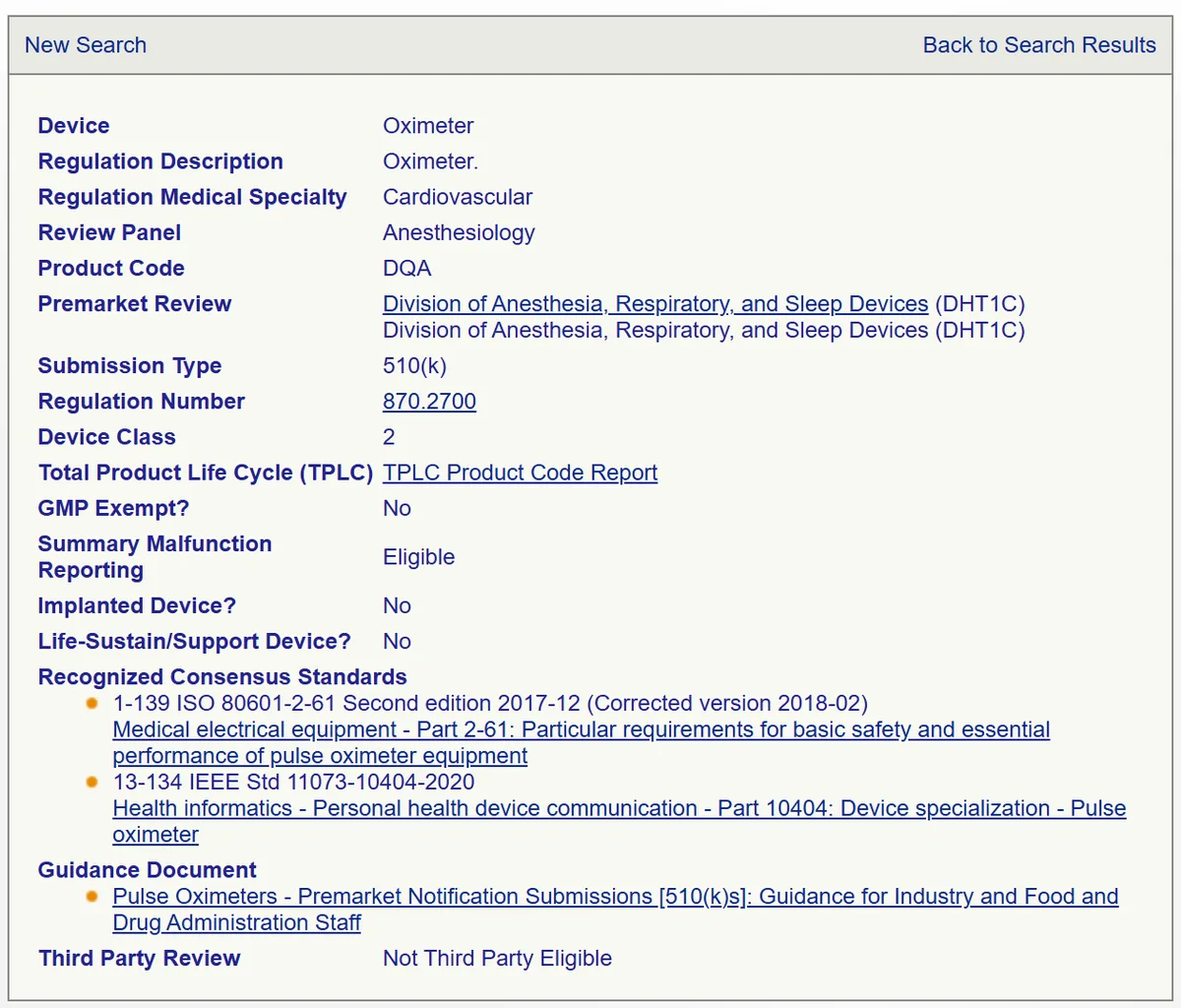
Before writing anything, look up how similar devices are classified in the FDA Product Classification database. Each device type has a three-letter product code, a regulation number, a device class and the submission type FDA expects.
The screenshot below shows the record for an oximeter: product code DQA, regulation 21 CFR 870.2700, Class 2, submission type 510(k). The record also links to the recognized standards and the FDA guidance for that device type. That is what tells you which tests you will need to show.
Step 2: choose a predicate in the 510(k) database
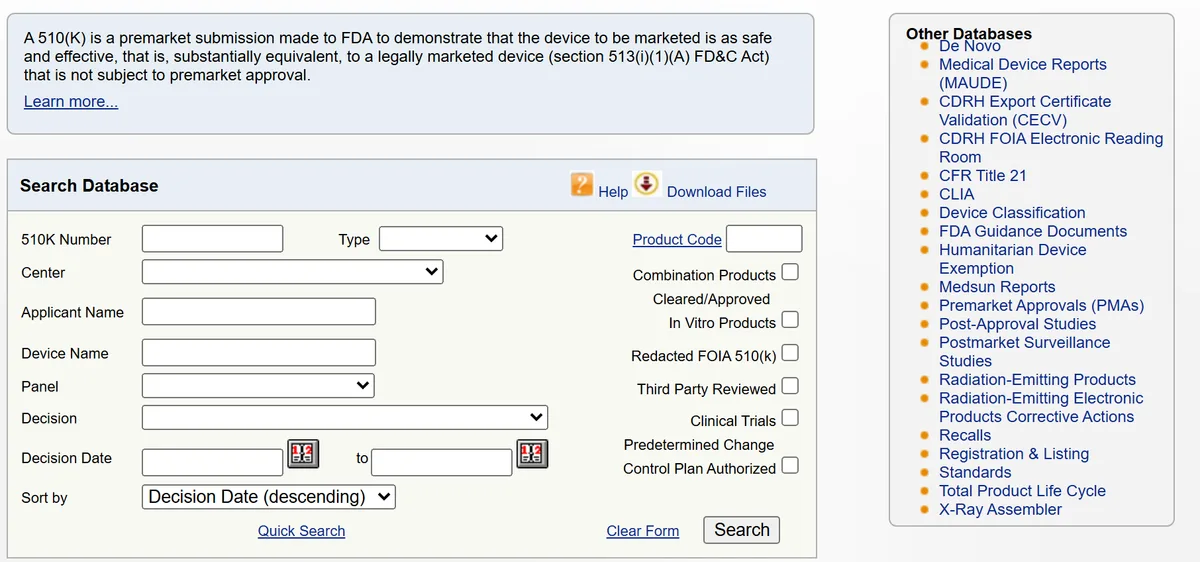
Search the FDA 510(k) database by the product code you found, by device name or by company. Each cleared device has a K number, a decision letter and usually a 510(k) Summary.
Read the predicate's summary carefully. It shows what the company claimed, which tests it presented and the exact Indications for Use that were cleared. If your intended use is different, or a technological difference raises a new safety or effectiveness question, the risk of an NSE decision goes up.
Step 3: ask FDA your open questions in a Pre-Submission
If you are unsure about the predicate, the test plan or whether you need clinical data, you can send FDA a Pre-Submission (Pre-Sub) under the Q-Submission program. It is a formal written request for feedback on specific questions. Under the current FDA guidance, written feedback is due within 70 days, and you can ask for a meeting after it.
A Pre-Sub is voluntary and it is not a pre-review of your submission. FDA recommends asking before you run the planned tests, because that is when the feedback is most useful.
Step 4: submit in eSTAR and follow the review clock
Since October 1, 2023, all 510(k) submissions, unless exempted, must be sent as electronic submissions using eSTAR, FDA's structured submission template. The review then runs like this:
- Acceptance review: within 15 days of receipt, FDA notifies you whether the submission was accepted for review.
- Substantive review: FDA's first substantive communication should come within 60 calendar days of receipt. It can be interactive review (questions by email or phone) or an Additional Information (AI) request.
- AI hold: after an AI request you have 180 calendar days to send a complete response. FDA grants no extensions beyond 180 days.
- Decision: the MDUFA goal is a decision within 90 FDA days. FDA days count from receipt and exclude the days the submission was on hold for your AI response. If there is no decision by day 100, FDA sends a Missed MDUFA Communication.
How long it really takes
The 90 days are an FDA review goal only. The clock stops whenever FDA waits for your answers, so the calendar time from submission to decision depends heavily on the quality of the file and how fast you respond.
The longer part is usually the work before submission: design controls, performance testing, biocompatibility, electrical safety and EMC where relevant, software and cybersecurity documentation, and risk management. How long that takes depends on the device and on what you already have.
Can you use clinical data from an Israeli study?
Yes, if the study meets FDA's conditions. Under 21 CFR 812.28, FDA accepts data from a clinical investigation conducted outside the US to support a 510(k), De Novo, PMA or IDE if the study is well designed, well conducted and run under good clinical practice (GCP). GCP includes review and approval by an independent ethics committee before the study starts and documented informed consent.
In Israel that ethics review is done by the institutional Helsinki Committee. See /en/guides/helsinki-committee-israel for how that approval works.
What it costs: FDA fees for fiscal year 2027
FDA fees change every fiscal year, which starts on October 1. For submissions from October 1, 2026 to September 30, 2027:
- 510(k) user fee: $28,653, or $7,163 for a business with an FDA small business determination (SBD).
- Annual establishment registration fee: $13,785. There is no small business rate. FDA may waive it, except for the initial registration, for certain qualified small businesses that show financial hardship.
- All 510(k) types (Traditional, Abbreviated and Special) pay the fee. There is no FDA user fee for a 510(k) submitted on behalf of an FDA-accredited third-party reviewer.
How to get the small business fee
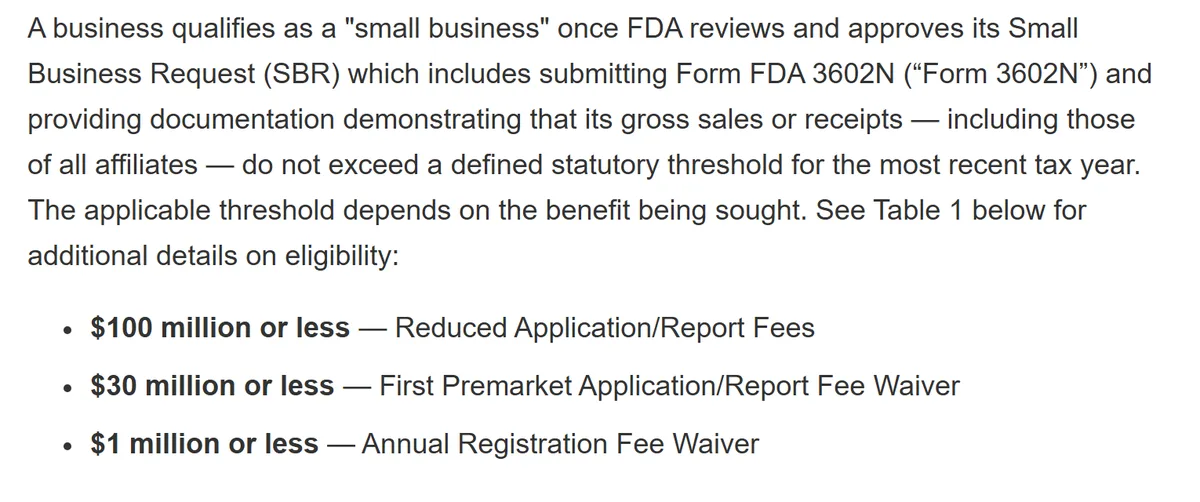
The reduced fee is not automatic. You file a Small Business Request on Form FDA 3602N and get FDA's decision before you pay. To qualify, gross receipts or sales of the company together with all its affiliates must be no more than $100 million for the most recent tax year.
An Israeli company can qualify. As a foreign firm it must include a certification from its National Taxing Authority (in Israel, the Israel Tax Authority) for itself and any foreign affiliates. The determination is valid for one fiscal year, so you apply again each year.
Common mistakes
Many avoidable delays come from a few early decisions:
- Picking a predicate that looks close but has a different intended use.
- Writing the Indications for Use too broadly, which pulls in tests and questions you did not plan for.
- Running a clinical study in Israel without checking first that it meets the GCP conditions FDA expects.
- Paying the full fee because the small business request was not filed in time for that fiscal year.
- Treating the 90-day goal as the full timeline and planning the fundraising around it.
How WeCcelerate works with founders on a 510(k) plan
WeCcelerate is a Venture Builder in Israel since 2018, active in Tel Aviv and Jerusalem and recognized by the Israel Innovation Authority. Our MedTech track runs in partnership with Leumit Health Services and gives founders clinical expertise, regulatory guidance, data access and pilot opportunities. We work with founders on the intended use, mapping similar devices in the FDA databases and building the regulatory plan, and connect it to the fundraising plan and clinical pilots.
Step by step
Step-by-step
Find your product code and class
Search the FDA Product Classification database for similar devices and note the product code, class, regulation number and required submission type.
Choose a predicate
Search the 510(k) database by product code and read the 510(k) Summary of each candidate to confirm the intended use matches yours.
Resolve open questions in a Pre-Submission
If the predicate, test plan or need for clinical data is unclear, ask FDA for written feedback before you run the tests.
Request small business status
If receipts, including affiliates, are no more than $100 million, file Form FDA 3602N with an Israel Tax Authority certification before paying the fee.
Submit in eSTAR and pay the fee
Prepare the submission in the eSTAR template, pay the user fee and send it to FDA.
Answer FDA requests on time
Respond to an Additional Information request within 180 calendar days at most. A fast, complete answer shortens the whole process.
FAQ
Frequently Asked Questions
How long does FDA 510(k) clearance take?
How much is the 510(k) fee in 2027?
Can an Israeli company get the small business fee?
Is eSTAR mandatory?
Will FDA accept clinical data from a study in Israel?
What happens if FDA finds my device not substantially equivalent?
Sources
The facts in this guide were checked against these official sources
- Premarket Notification 510(k) · FDA
- 510(k) Submission Process · FDA
- Medical Device User Fee Amendments (MDUFA): Fees · FDA
- Reduced Medical Device User Fees: Small Business Determination (SBD) Program · FDA
- Requests for Feedback and Meetings for Medical Device Submissions: The Q-Submission Program · FDA
- De Novo Classification Request · FDA
- 21 CFR 812.28 -- Acceptance of data from clinical investigations conducted outside the United States · eCFR
- Product Classification: Oximeter (DQA) · FDA
Plan your 510(k) with the WeCcelerate MedTech track
The WeCcelerate team has supported ventures launched that collectively significant capital raised. Start with a free introductory call.
Related reads