Helsinki Committee Israel: how clinical study approval works for MedTech founders
The Helsinki Committee is the ethics committee of an Israeli medical institution. Under the Public Health Regulations of 1980 and Ministry of Health Procedure 14, a medical study in humans needs the committee's approval and the institution director's written approval before any participant is enrolled. Some device trials also need Ministry of Health approval.
What the Helsinki Committee is
Israeli medical institutions that run research in humans have an institutional Helsinki Committee, the local equivalent of an IRB or independent ethics committee. It works under the Public Health Regulations (Medical Experiments in Human Subjects), 1980, and the Ministry of Health's Procedure 14 on clinical trials in humans. The name comes from the World Medical Association's Declaration of Helsinki, adopted in June 1964 and last amended in October 2024.
Under the regulations, the Director General's authority to approve medical experiments in humans is delegated to the directors of medical institutions. The director approves a study only after the institutional committee approves it. When a study also needs Ministry of Health approval, the director signs only after that approval arrives too. Procedure 14 builds on ICH-GCP and, for devices, on ISO 14155.
Who sits on the committee
Procedure 14 requires at least seven members: a public representative who is a cleric or a lawyer and not an employee of the institution, three senior physicians (one of them the chair, and at least one an internal medicine specialist), a physician representing management, a senior pharmacist, and an expert with a PhD in a health profession or an expert in ethics or product safety, such as biomedical engineering or biostatistics.
A decision on a new study needs a quorum of at least five members. For studies that use only existing data or questionnaires, the institution director can let a subcommittee of at least three members review them. The Ministry of Health approves the committee's appointment, and the appointment is valid for 24 months.
Which studies need approval
Procedure 14 applies to all types of medical research in humans covered by the 1980 regulations. For a MedTech startup this usually means one of three situations:
- A clinical trial or pilot of your device or software on patients.
- A study that collects new data from people, for example a prospective study with questionnaires or measurements.
- A retrospective study on existing medical records, for example to train or validate an algorithm. This still needs approval, but the institution may route it to the subcommittee. The committee can waive informed consent for research on de-identified data, provided the de-identification is done only by authorized staff inside the health organization.
"Special" and "non-special" trials: when the Ministry of Health is involved
Within two working days of receiving a complete application, the committee chair classifies the study as "special" or "non-special". A special trial needs only the institutional committee and the director. A non-special trial is sent to the Ministry of Health in parallel to the committee review.
For devices, Procedure 14 lists the cases that can be classified as special. Examples: a trial with a recognized device used for its accepted indication, where treatment and follow-up are no different from usual care; an efficacy trial, after earlier safety trials in a recognized country or in Israel were completed successfully and reported in the protocol; and collecting data that is not part of routine care with a recognized, non-invasive device such as ECG, EEG or ultrasound. A trial that fits none of these cases, such as a first safety study of a new device, is non-special and goes to the Ministry's unit for clinical trials in medical devices and advanced therapies. The application form for a device trial is Form 1b.
For non-special trials, the Ministry's decision is due within 60 working days of a complete application if a ministry committee discusses it, 45 working days if it goes to expert opinion, and 30 working days if it is handled by professional review in the department. Time spent waiting for your corrections does not count. You can submit corrections once, within six months of the decision letter. Ministry approval is issued on Form 8. Genetic studies and some other categories go to the Supreme Helsinki Committee, which meets monthly and decides about four weeks after receiving the file from the institutional committee.
What to prepare
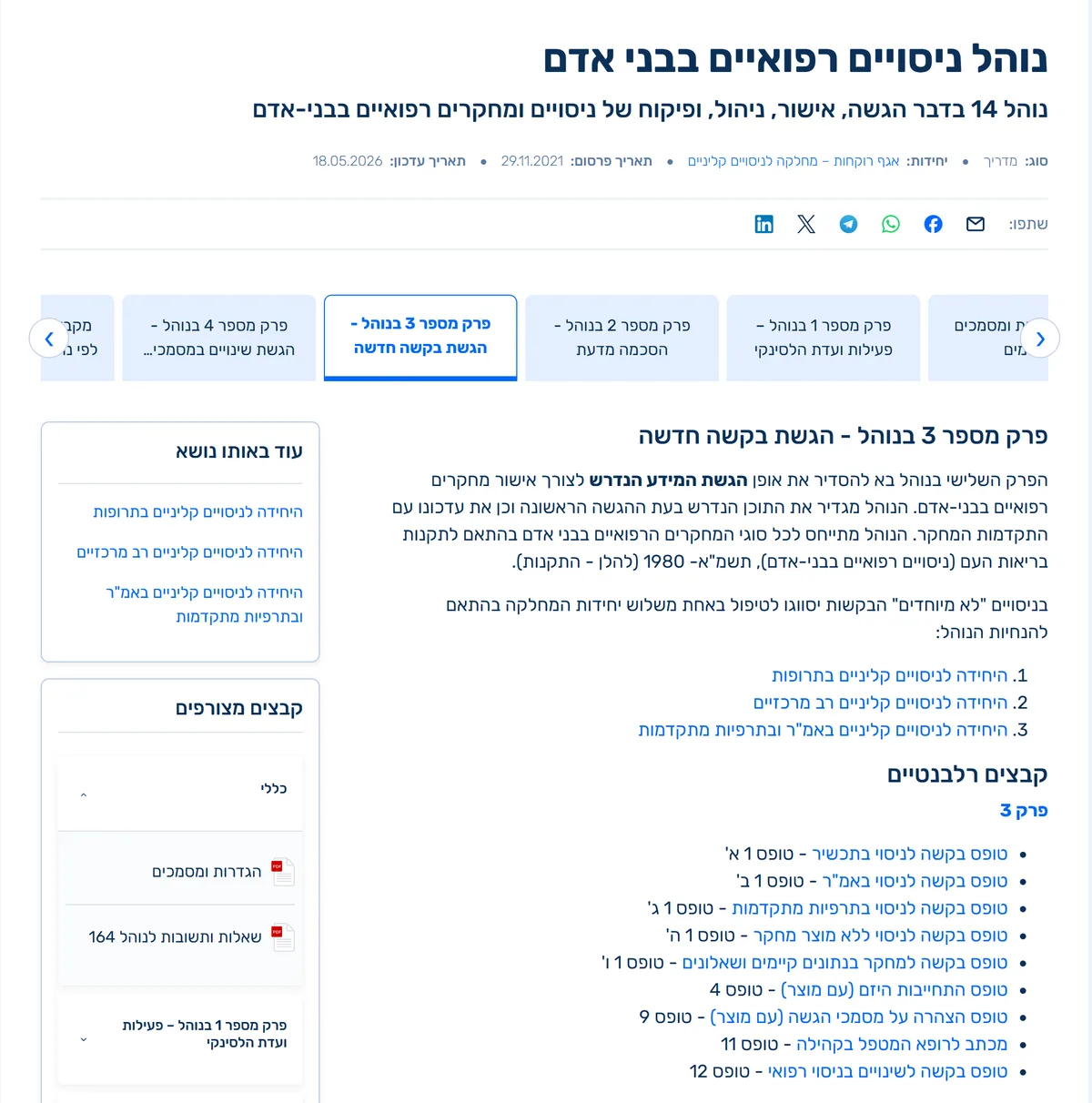
The committee reviews, among other things, the protocol, the investigator's brochure, safety information, the letter to the participant's treating physician (Form 11), any payment offered to participants, and the investigators' CVs and training. For a device trial:
- Protocol written according to ISO 14155 Annex A, and an investigator's brochure according to Annex B.
- Informed consent form in plain language without medical jargon, no longer than 15 pages, in a font no smaller than 12. The approved Hebrew version is the source for translations, and each participant gets the form in a language they read.
- Investigators with GCP training. Medical decisions in the trial are the responsibility of a licensed physician.
- Sponsor commitment (Form 4) and the declaration on submission documents (Form 9).
- Insurance: a commercial sponsor must insure against participant and third-party claims under Israeli law, with a limit of at least $3,000,000, and give the institution an insurance certificate.
After approval
Once the committee approves (Form 6), the sponsor registers the trial on the Ministry's MyTrial site where required, and only then can the director sign the approval to run it (Form 7). You may not enroll anyone before the director's written approval.
During the trial, changes to documents go to the committee on Form 12, and the committee follows the trial at least once a year. Participants must not pay to take part, and the sponsor supplies the investigational product free of charge for the whole trial.
Using the data for FDA
Under 21 CFR 812.28, FDA accepts data from clinical investigations outside the US to support a 510(k), De Novo, PMA or IDE if the study is well designed, well conducted and follows good clinical practice, including review and approval by an independent ethics committee before the study starts. A Helsinki Committee approval is that review in Israel. See /en/guides/fda-510k-israeli-startups for the 510(k) side.
If your product uses AI, note that the Ministry's clinical trials department has published principles for evaluating AI-based interventional clinical trials.
Common mistakes
Preparation gaps that cost founders time:
- Assuming a retrospective data study does not need approval.
- A consent form that reads like a protocol, too long or full of medical terms.
- Not checking early whether the trial will be special or non-special, and planning a timeline that ignores the Ministry review.
- Missing sponsor insurance or an unsigned contract with the institution.
- Starting to recruit after committee approval but before the director's signature.
How WeCcelerate works with founders on clinical studies
WeCcelerate is a Venture Builder in Israel since 2018, active in Tel Aviv and Jerusalem and recognized by the Israel Innovation Authority. Our MedTech track runs in partnership with Leumit Health Services and gives founders clinical expertise, regulatory guidance, data access and pilot opportunities, all subject to the required Helsinki approvals. We help founders plan the study, prepare the submission and connect it to the regulatory and fundraising plan.
Step by step
Step-by-step
Choose the institution and principal investigator
Each institution has its own committee. Start with the site where your principal investigator works and where the study will run.
Check the classification early
Use Procedure 14 to estimate whether the study will be special or non-special, so you know if the Ministry of Health will review it too.
Prepare the documents
Protocol and investigator's brochure (ISO 14155 for devices), consent form, the Procedure 14 forms, investigator CVs and GCP training, and sponsor insurance.
Submit to the institutional committee
Submit through the institution's committee office. Non-special trials go to the Ministry of Health in parallel.
Answer requests and register the trial
Respond to committee and Ministry comments, then register on MyTrial where required after the committee approval.
Start only after the director signs
Begin enrollment only after the institution director's written approval, and keep reporting changes and progress to the committee.
FAQ
Frequently Asked Questions
What is the Helsinki Committee in Israel?
How long does Helsinki Committee approval take?
Do I need approval for a retrospective data study?
When does the Ministry of Health need to approve a device trial?
Can I start recruiting once the committee approves?
Will FDA accept data from a study approved by a Helsinki Committee?
Sources
The facts in this guide were checked against these official sources
- נוהל ניסויים רפואיים בבני אדם · Israel Ministry of Health
- נוהל 14 פרק 1: פעילות ועדת הלסינקי · Israel Ministry of Health
- נוהל 14 פרק 2: הסכמה מדעת · Israel Ministry of Health
- נוהל 14 פרק 3: הגשת בקשה חדשה · Israel Ministry of Health
- ועדת הלסינקי העליונה לניסויים רפואיים בבני-אדם (מחקר גנטי) · Israel Ministry of Health
- אגף רוקחות – מחלקה לניסויים קליניים · Israel Ministry of Health
- WMA Declaration of Helsinki · World Medical Association
- 21 CFR 812.28 -- Acceptance of data from clinical investigations conducted outside the United States · eCFR
Plan your clinical study with the WeCcelerate MedTech track
The WeCcelerate team has supported ventures launched that collectively significant capital raised. Start with a free introductory call.
Related reads