How to raise startup funding in Israel: a founder's guide
To raise startup funding in Israel, match the source to your stage: founders, angels and Israel Innovation Authority grants for the earliest stage, then seed and Series A investors once you show progress. Prepare a clear deck, a financial model and a clean cap table, and check securities law limits with a lawyer before you approach investors.
How does startup fundraising work in Israel?
Startup fundraising in Israel moves in stages, and each stage has its own typical investors and proof points. The money you raise at each stage should get the company to the milestone that makes the next round possible.
The labels are not legal terms, and investors use them loosely. Still, the logic is consistent:
- Pre-seed: founders, friends and family, angel investors, and public programs such as Israel Innovation Authority grants. The goal is to test the problem and build a first version.
- Seed: angels, angel groups and seed funds. The goal is to show early users, customers or strong technical progress.
- Series A: venture capital funds, often with foreign investors. The goal is to scale something that already works.
- Later rounds: growth funds and strategic investors, driven by revenue and growth.
What non-dilutive funding is available?
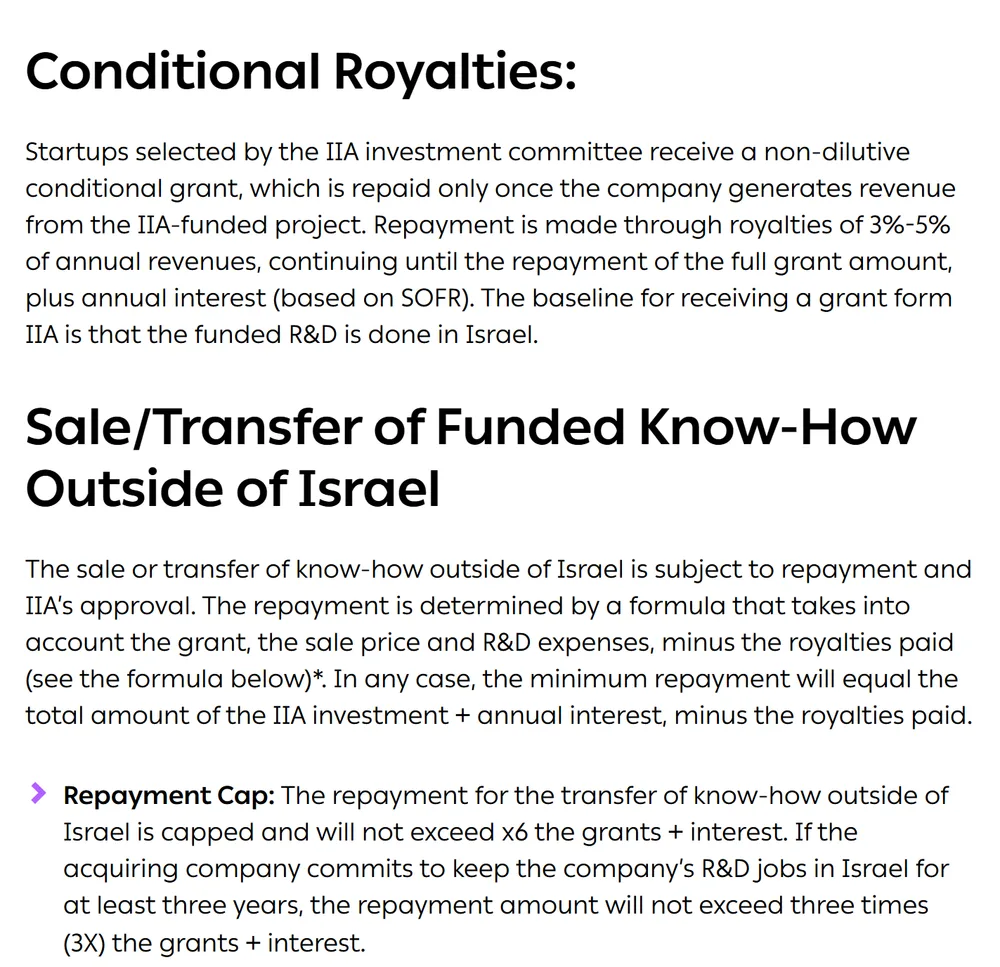
The main non-dilutive source for Israeli tech startups is the Israel Innovation Authority (IIA), which invests through conditional grants from the ideation stage through pre-seed, seed and A rounds. A grant does not cost equity. It is repaid only once the company earns revenue from the funded project, through royalties of 3% to 5% of annual revenues plus annual interest based on SOFR, until the full grant is repaid.
Two conditions matter for later fundraising. The funded R&D must be done in Israel, and selling or transferring the funded know-how outside Israel needs IIA approval and a repayment. Investors will ask about both in due diligence.
For the very first step, the IIA's Ideation (Tnufa) program offers entrepreneurs and new Israeli startups a conditional grant of up to NIS 200,000 over 12 months, covering 80% of the approved budget. The money goes to a first prototype, IP protection and business development, not to salaries. Check the current terms on the IIA site before you apply.
SAFE or equity round: which instrument should you use?
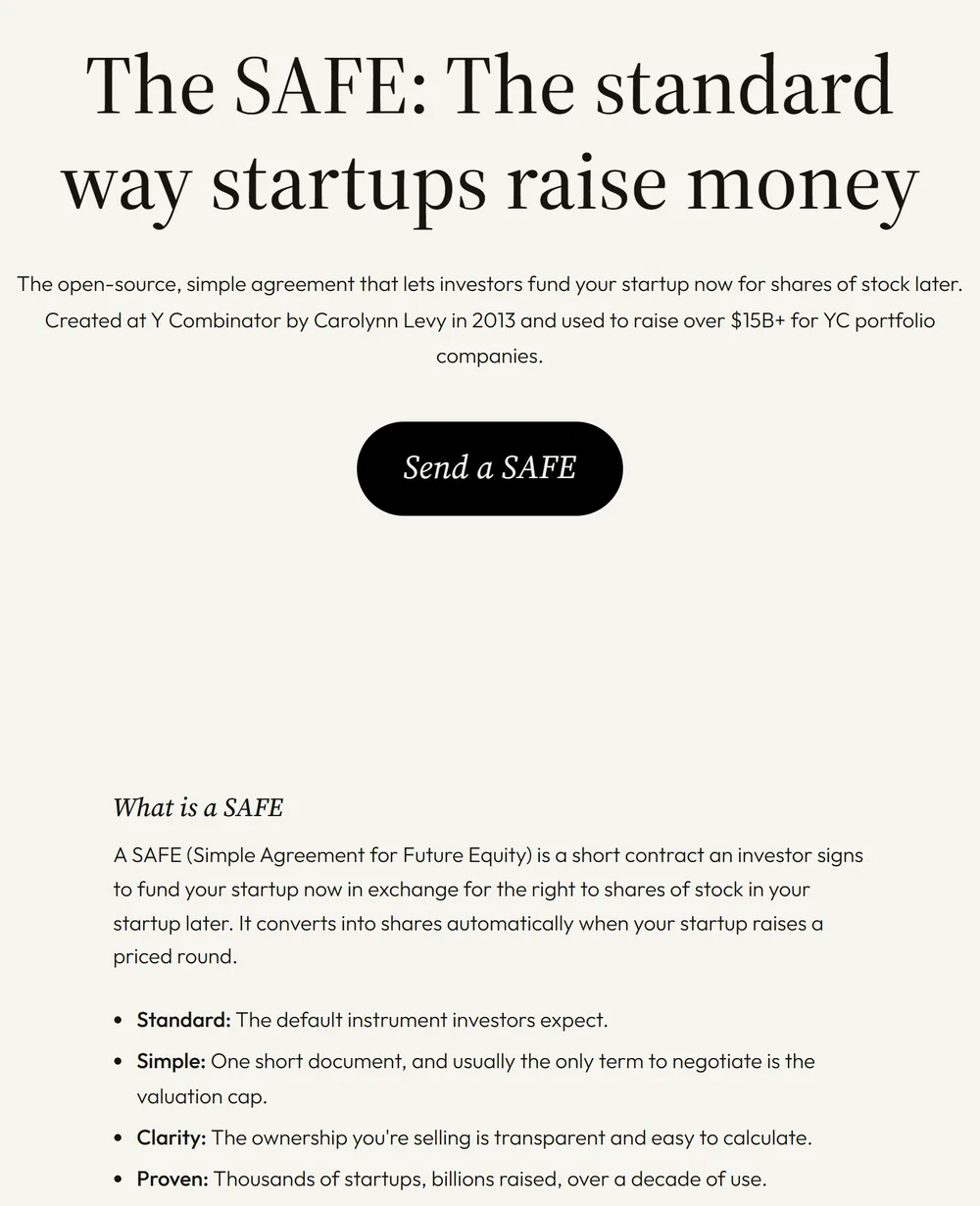
Early rounds are usually done either as a priced equity round, where investors buy shares at an agreed valuation, or with a convertible instrument such as a SAFE, which turns into shares at a later priced round.
The SAFE (Simple Agreement for Future Equity) was created at Y Combinator in 2013, and the post-money SAFE has been YC's standard since 2018. YC describes it as a short contract that converts into shares when the company raises a priced round, and states that it is not debt. Its standard versions use a valuation cap, a discount, or an MFN clause, with pro rata rights in a separate side letter.
One detail matters for Israeli founders: YC's forms and tool are built for US-incorporated companies, and its non-US forms cover Canada, the Cayman Islands and Singapore. If your company is an Israeli Ltd., ask your lawyer which instrument fits Israeli corporate and tax law.
What does Israeli securities law mean for a private round?
Under Israel's Securities Law, 1968, nobody may offer securities to the public without a prospectus approved by the Israel Securities Authority. Section 15A sets out what does not count as an offer to the public, and that is the room most private rounds work in.
In short, selling to a limited number of investors within any 12-month period is not a public offer, and the exact number is set in regulations under the law. Investors of the types listed in the law's First Schedule, such as certain institutional and qualified investors, are not counted. Posting a round widely on social media can still create a problem, so plan who you approach with a lawyer.
How should you prepare before meeting investors?
Prepare the materials investors will ask for before the first meeting, so that a good conversation does not stall on missing documents. Most early investors expect:
- A short pitch deck that tells the story clearly (see /en/guides/startup-pitch-deck).
- A financial model with explicit assumptions (see /en/guides/startup-business-plan).
- A clean cap table, signed founder agreements with vesting, and IP assigned to the company (see /en/guides/vesting-explained).
- A list of investors that actually invest at your stage and in your sector.
- A clear answer to how much you are raising and which milestones it will fund.
Common fundraising mistakes
Most early rounds stall for reasons the founder controls. Watch for these:
- Raising before you can show a milestone that matters to investors at that stage.
- Approaching investors who do not invest at your stage or in your sector.
- Signing a convertible instrument without understanding how it dilutes you at conversion.
- Ignoring IIA conditions on R&D location and know-how transfer when planning the company structure.
- Talking to many unqualified investors without checking securities law limits.
- Leaving the cap table, vesting and IP assignment to be fixed during due diligence.
How WeCcelerate works with founders on fundraising
WeCcelerate is a Venture Builder in Israel since 2018, active in Tel Aviv and Jerusalem and recognized by the Israel Innovation Authority. We work with founders on the investment story, the deck, the financial model and preparation for investor meetings. MedTech founders can also join our track with Leumit Health Services, which offers clinical expertise, regulatory guidance, data access and pilot opportunities.
Step by step
Step-by-step
Define the milestone
Decide what the round must achieve, such as a working prototype, first customers or a regulatory step, and how much money that takes.
Check non-dilutive options
Review Israel Innovation Authority programs that fit your stage, and their conditions on R&D in Israel and know-how transfer.
Clean up the company
Sign founder agreements with vesting, assign IP to the company and make sure the cap table is accurate.
Prepare the materials
Build a short deck, a financial model with clear assumptions and a basic data room.
Choose the instrument
Decide with your lawyer between a priced round and a convertible instrument that fits an Israeli company.
Build a targeted investor list
List investors who invest at your stage and in your sector, and plan your approach within securities law limits.
Run the process and close
Hold meetings in a focused period, negotiate the term sheet with your lawyer and close the legal documents.
FAQ
Frequently Asked Questions
Where does early startup funding in Israel come from?
How do Israel Innovation Authority grants work?
What is the IIA Tnufa program?
What is a SAFE?
Can an Israeli startup raise from many private investors?
What documents do investors ask for in an early round?
Sources
The facts in this guide were checked against these official sources
- Royalties & Intellectual Property · Israel Innovation Authority
- Ideation (Tnufa) Incentive Program - Startup Fund · Israel Innovation Authority
- The SAFE: The standard way startups raise money · Y Combinator
- Securities Law, 5728-1968 (Hebrew text) · Hebrew Wikisource
Prepare for your fundraise with WeCcelerate
The WeCcelerate team has supported ventures launched that collectively significant capital raised. Start with a free introductory call.
Related reads