A founder's guide: how to start a startup in Israel
To start a startup in Israel, first confirm that real customers have the problem. Then register a company with the Israel Corporations Authority, which offers online registration, sign a founder agreement with vesting, assign the IP to the company, build a focused MVP, and fund the first stage through founders, angels or Israel Innovation Authority programs.
What is the first step in starting a startup?
The first step is to confirm that a specific group of customers has the problem you want to solve, before you incorporate or write code. A company, a founder agreement and a product all cost money, and none of them help if the problem is not real or not urgent.
Talk with people from the target audience, not friends and family. Ask how they handle the problem today, what it costs them and what they have already tried. Look for repeated pain and for signs that people would pay or change their behavior. Write down what you learn, because it will shape the MVP, the business plan and the pitch.
How do you register a company in Israel?
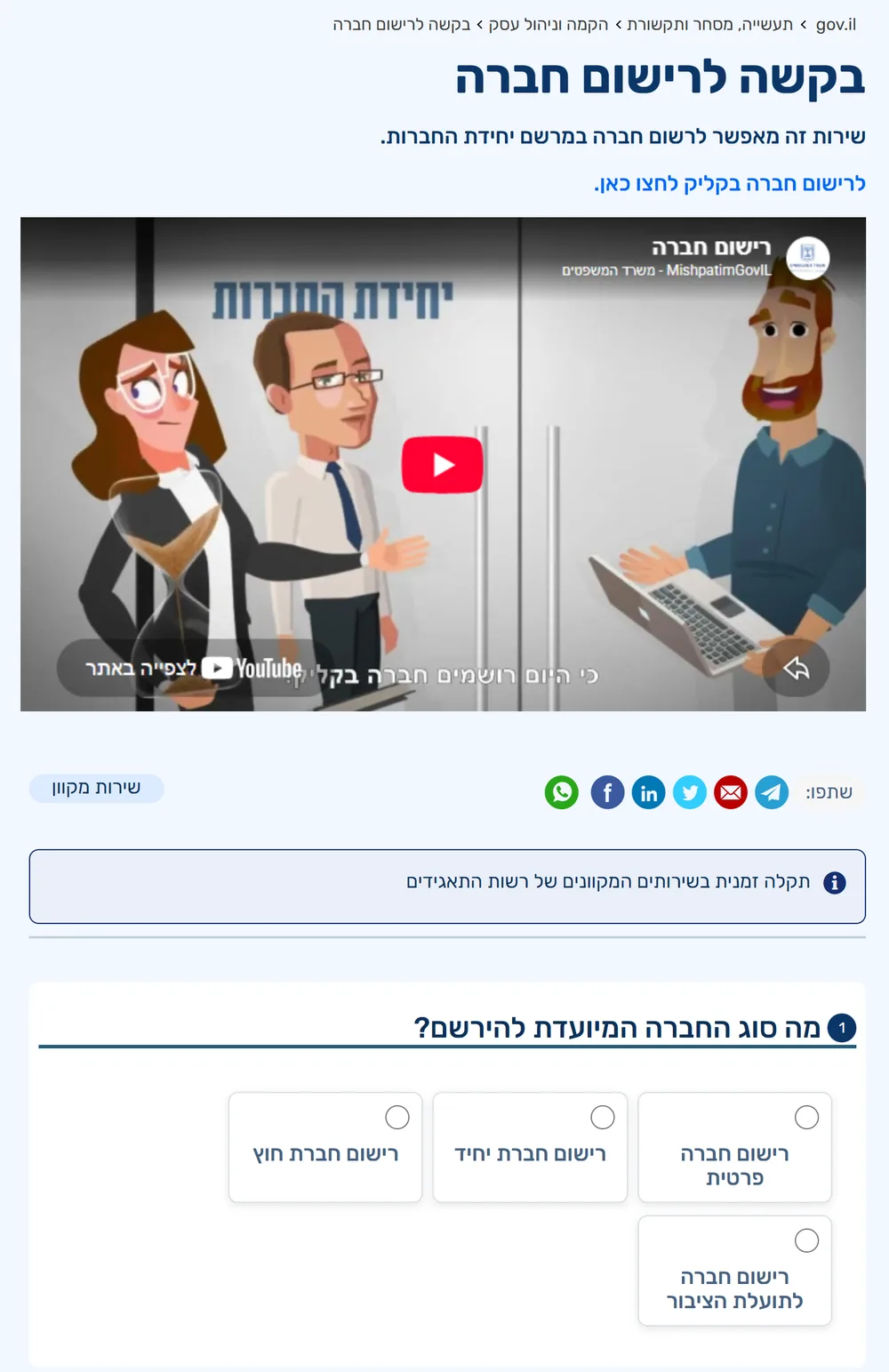
You register a company in Israel with the Companies Registrar at the Israel Corporations Authority, part of the Ministry of Justice, and the registration can be filed online on gov.il. The service lets you choose the company type, such as a private company, a single-shareholder company, a foreign company or a public benefit company.
Most startups register as a private company limited by shares (Ltd.). Before you file, agree with your co-founders on the shareholders, the directors and the share split, and decide whether you need custom articles of association. The Authority publishes guides for the online process and the forms, including declarations by the first directors and shareholders. A registered company also pays an annual fee to the Authority, so keep it on your calendar.
Israeli company or Delaware company?
For most Israeli founders an Israeli company is the simple default. A US (often Delaware) parent company becomes relevant when most of your investors, customers or management will be in the US, and some investors ask for it.
The choice has tax, legal and grant consequences, including for Israel Innovation Authority funding, which requires the funded R&D to be done in Israel and IIA approval to transfer funded know-how abroad. Changing the structure later costs time and legal fees, so discuss it with a lawyer and an accountant before your first round, not during it.
What should a founder agreement include?
A founder agreement should set out who owns what, how the shares vest, what each founder is responsible for, and what happens if someone leaves. Sign it when you start working together, not after the first round.
A common structure, which Y Combinator describes as typical, is four years of vesting with a one-year cliff: nothing vests in the first year, a quarter vests at the one-year mark, and the rest vests monthly. Also include an assignment of all IP to the company, confidentiality, and clear good leaver and bad leaver terms. Our guide /en/guides/vesting-explained explains how vesting works.
How focused should the first product be?
The first product should test the single most important assumption behind the business, and nothing more. Eric Ries defines the minimum viable product as the version of a new product that lets a team collect the maximum amount of validated learning about customers with the least effort.
Decide in advance what you want to learn and how you will measure it, then build only what that test needs. See /en/guides/how-to-build-mvp for a step-by-step approach.
How do you fund the first stage?
Early money usually comes from the founders, friends and family, angel investors and public programs. The Israel Innovation Authority's Ideation (Tnufa) program offers entrepreneurs and new Israeli startups a conditional grant of up to NIS 200,000 over 12 months, covering 80% of the approved budget, for a prototype, IP protection and business development.
IIA grants are repaid only from revenue of the funded project, through royalties of 3% to 5% of annual revenues plus SOFR-based interest. Our guide /en/guides/raise-funding-israel covers seed rounds, SAFEs and securities law limits.
Can a foreign founder start a startup in Israel?
Yes. Since 2024 the Israel Innovation Authority, together with the Population and Immigration Authority, runs an Innovation Visa procedure for foreign technology entrepreneurs who want to set up a company in Israel. The IIA only recommends. The visa itself, a B/2 stay permit for up to two years, is granted by the Population and Immigration Authority.
The application must name a supporting framework that will accompany the entrepreneur, include that framework's declaration of support, explain how living costs will be funded, and describe R&D to be done in Israel.
Common mistakes when starting a startup
These early mistakes are common and expensive to fix later:
- Incorporating and building before talking with real customers.
- Splitting equity without vesting, or postponing the founder agreement.
- Leaving IP with a founder or a contractor instead of the company.
- Choosing a corporate structure without checking tax and grant consequences.
- Building a full product when a small test would answer the key question.
How WeCcelerate works with early-stage founders
WeCcelerate is a Venture Builder in Israel since 2018, active in Tel Aviv and Jerusalem and recognized by the Israel Innovation Authority. We work with founders from the early stage on testing the problem, the business model, the product and preparation for fundraising. Our MedTech track with Leumit Health Services gives founders clinical expertise, regulatory guidance, data access and pilot opportunities.
Step by step
Step-by-step
Validate the problem
Interview people from your target audience about how they handle the problem today and what it costs them.
Agree on the founding team
Agree on roles, the share split and commitment before you register.
Register the company
File an online company registration with the Israel Corporations Authority on gov.il.
Sign a founder agreement
Include vesting, IP assignment to the company, confidentiality and leaver terms, drafted by a lawyer.
Build a focused MVP
Test the single most important assumption with the smallest product that can test it.
Fund the first stage
Combine founder money, angels and Israel Innovation Authority programs such as Tnufa.
Talk to WeCcelerate
Book an introductory call about building your venture.
FAQ
Frequently Asked Questions
How do I register a startup company in Israel?
Should my startup be an Israeli company or a Delaware company?
What vesting schedule should founders use?
Can I get government funding for a new startup in Israel?
Can a foreigner start a startup in Israel?
Do I need a technical co-founder to start?
Sources
The facts in this guide were checked against these official sources
- בקשה לרישום חברה (Company registration request) · Israel Corporations Authority, Ministry of Justice
- Ideation (Tnufa) Incentive Program - Startup Fund · Israel Innovation Authority
- Royalties & Intellectual Property · Israel Innovation Authority
- Innovation Visa for a Foreign Technology Entrepreneur · Israel Innovation Authority
- How to Split Equity Among Co-Founders · Y Combinator
- Minimum Viable Product: a guide · Eric Ries, Startup Lessons Learned
Start your Israeli startup with WeCcelerate
The WeCcelerate team has supported ventures launched that collectively significant capital raised. Start with a free introductory call.
Related reads